


In a market flooded with "disposable" furniture that rarely lasts more than three years, buying a quality sofa has become an act of resistance as much as a thoughtful financial investment. Statistics from the furniture industry are alarming: nearly 40% of entry-level sofas show signs of sagging or structural failure after just 18 months of daily use. Yet, truly quality furniture should be the anchor of your home for the next decade, combining impeccable technical design with tried-and-tested materials. Understanding what lies beneath the surface—from the density of the foam to the woodwork of the frame—is the only way to ensure your money is spent on lasting comfort and exceptional durability, far removed from superficial marketing promises.
What technically defines a truly high-quality sofa?
Far from the purely aesthetic considerations that define a designer sofa , the intrinsic quality of a seat rests on a precise technical equation. It is the synergy between the structure, the suspension, the padding, and the upholstery that determines the product's longevity. A good quality sofa is not the result of chance, but the product of rigorous engineering.
The crucial importance of density
The number one criterion, often overlooked by the general public but revered by upholsterers, is the foam density. This is what guarantees that your sturdy sofa will retain its shape year after year. For a seat, a density below 28 kg/m³ is synonymous with planned obsolescence. A reputable manufacturer aims for High Resilience (HR) foam of at least 30 to 35 kg/m³. This has nothing to do with firmness, but everything to do with the material's ability to return to its original shape after compression.
Choosing a sofa with good padding is therefore the first step to avoiding the unsightly and uncomfortable "bowl" effect. It's this technical aspect that distinguishes a lasting investment from a fleeting expense.
The structure: the skeleton of longevity
If the foam is the muscle, the frame is the skeleton. A sturdy sofa must rest on a structure capable of withstanding daily mechanical stresses: children jumping, moving house, or simply the repeated weight of its users. The joints must be glued and screwed, not simply stapled as is the case with entry-level models.
At the heart of a proper living room sofa , you often find crossbeams made of solid wood (reinforced beech or pine) or high-density particleboard, ensuring essential torsional rigidity, especially for large formats like the panoramic sofa .
Our selection criteria for maximum durability
At Kings Canapé, we have established strict specifications. For a model to be considered a durable sofa , it must meet precise requirements that exceed the usual market standards.
Time-resistant materials
Sustainability begins with the choice of raw materials. We prioritize internal structures that won't warp under variations in humidity or temperature. This is particularly crucial for a solid wood sofa , where the selection of the wood species and its drying time are key to preventing future creaking.
The mechanical resistance of the mechanisms
A durable, modern sofa often incorporates moving parts. Whether it's a convertible model or a seat with headrests, the hardware must be made of reinforced steel. A sofa mechanism with a reclining backrest , for example, undergoes thousands of opening and closing cycles. The quality of the axles and pistons is therefore non-negotiable to maintain smooth movement for ten years.
The Martindale test: The ultimate test of fabric
How can you tell if the fabric of your future modern sofa won't tear or pill? Look at the Martindale rating. This industry test measures abrasion resistance. A standard household fabric has a rating of around 15,000 rubs. For a quality sofa , we aim for fabrics exceeding 25,000, or even 40,000 rubs, guaranteeing impeccable durability even with children or pets, while maintaining the elegance of a chic and contemporary sofa .
How to recognize a good quality sofa? (The Expert's Checklist)
The savvy buyer knows how to decipher the telltale signs. Here are the essential checkpoints to validate your purchase and ensure you acquire a sofa with high-quality finishes .
| Checkpoint | What to look for (Sign of Quality) | The trap to avoid |
|---|---|---|
| The Weight | A solid sofa is heavy. This indicates a dense structure and solid materials. | A sofa that is too light and slips at the slightest touch indicates a cardboard or hardboard structure. |
| The Seams | Regular, tight stitching, and often doubled in high-stress areas. That's the hallmark of a well -made, high-end sofa . | Loose threads, skipped stitches or simple seams on the seat that will quickly come undone. |
| The Suspension | Nozag springs (coil-like) or high-density interwoven elastic straps. | Seat placed on a board or straps too far apart which create hollows. |
| The Assisi | The initial feel can be soft, but the support must be firm throughout. A firm seat on a sofa protects your back. | A smooth seat where you can feel the wooden structure as soon as you sit down a little too hard. |
These checks are all the more important if you opt for complex configurations such as a trendy designer sofa with organic shapes, where the tension on the fabric is greater than on a classic straight model.
A range adapted to your intensive use
The concept of a quality sofa also varies depending on how you intend to use it. A couple without children doesn't have the same sturdiness requirements as a large family. That's why we adapt our technical recommendations.
For large families: Structure is the priority
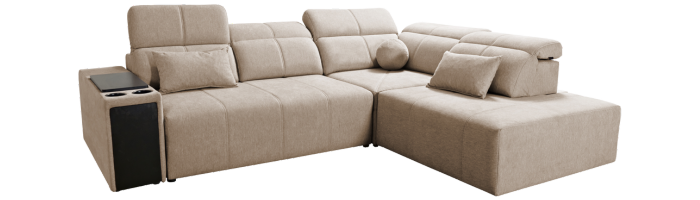
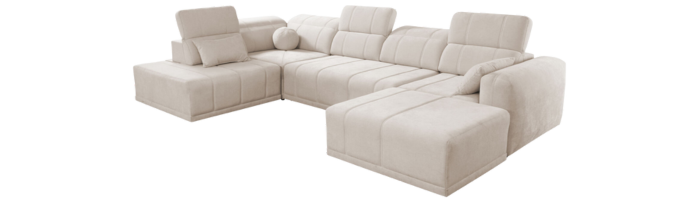
If your sofa is the children's playground and the family gathering place, opt for a durable model. Corner sofas offer excellent weight distribution thanks to their multiple reinforcing legs. Furthermore, modularity is a maintenance advantage: on a modular sofa , if a module is accidentally damaged, it can be replaced without changing the entire piece of furniture, thus significantly extending the overall lifespan of your investment.
For relaxation enthusiasts: Electrical reliability
Technological comfort demands heightened vigilance. Our electric reclining sofas are equipped with certified motors, tested for thousands of cycles. Quality here lies in the quietness of the mechanism and the smoothness of the opening. A low-quality motor will jerk and eventually burn out; a quality mechanism will support you effortlessly for years.
For small spaces: Robust optimization
Just because a sofa is small doesn't mean it has to be fragile. On the contrary, a compact , straight sofa often experiences more concentrated wear in the same area. We reinforce the seats of our compact models to prevent premature wear of the foam, thus guaranteeing a high-quality sofa even in a studio apartment.
Comfort: A consequence of technical quality
Durability and comfort are often seen as opposing forces, with the mistaken assumption that a sturdy sofa must be as hard as a rock. This is a mistake. True, lasting comfort stems from the quality of the supporting materials. An ultra-comfortable sofa isn't a bag of soft beads, but a complex structure of layered foams of varying densities.
For those seeking a superior seating experience, adding options like a sofa with an integrated mattress topper allows you to combine the resilience of a high-density base with the plush feel of a contact layer, without compromising durability.
Similarly, for those who like to stretch out, a sofa with a large seat or extra-deep seat requires a frame reinforced in the center to prevent it from sagging under its own overhang. It is this invisible attention to the structure that allows for bold designs like the deep-seated sofa without the risk of sagging.
Aesthetics and Sustainability: Italian Inspiration
It is possible to combine beauty and durability. The Italian design school understood this well. By drawing inspiration from Italian designer sofas , we embrace not only clean lines but also a culture of manufacturing excellence. Contemporary sofa style should not be an excuse for fragility. On the contrary, clean lines demand perfect fabric tension and millimeter-precise alignment that allow for no manufacturing imperfections.
Why choose Kings Sofa for your investment?
Choosing quality furniture from Kings Canapé means choosing transparency. We don't just sell style, we sell peace of mind. Every model, from the most compact to the largest, undergoes rigorous quality control. We understand that buying a durable sofa is a significant financial investment for a household.
That's why we incorporate practical and durable features, such as the sofa with storage compartment , whose hinges are reinforced to withstand daily use. It's this obsession with technical detail, invisible to the naked eye but noticeable in everyday use, that has built our reputation.
Frequently Asked Questions about Sofa Quality
What foam density should I choose for a quality sofa?
For a good quality sofa that lasts, choose high-resilience (HR) foam with a minimum density of 30 kg/m³ for the seat cushions, and ideally 35 kg/m³. Below 28 kg/m³, the foam is likely to sag and lose its elasticity in less than two years. For the backrest, a density of 20 to 25 kg/m³ is sufficient as it supports less weight.
What is the difference between a quality sofa and a luxury sofa?
The difference often lies in the exclusivity of the materials and the prestige of the brand. A quality sofa focuses on technical robustness, the durability of the foam, and the strength of the assembly for intensive use. Luxury sofas add rare materials (exotic full-grain leathers, precious woods), signatures from famous designers, and highly refined hand-finishing, which increases the price without necessarily doubling the structural robustness compared to a very good premium model.
How to maintain your sofa so that it stays "like new"?
Durability also depends on maintenance. Vacuum the fabric regularly to prevent dust from acting as an abrasive on the fibers. If you have a comfortable sofa with removable cushions, fluff them and rotate them regularly to distribute wear on the foam. Finally, tighten the legs once a year to maintain the frame's rigidity.
Is a convertible sofa less sturdy than a fixed sofa?
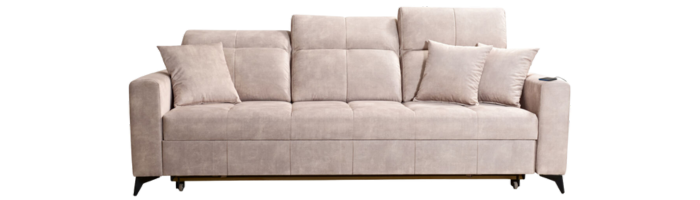
That used to be true, but not anymore for higher-quality models. A modern convertible sofa incorporates an independent metal frame (the base) which often reinforces the overall rigidity of the sofa. If the mechanism is robust and the frame well-proportioned, it will be just as durable as a fixed model, while offering dual functionality.
Conclusion: Quality, the only necessary luxury
Ultimately, choosing a quality sofa is the most sensible decision for your home. Beyond fleeting trends, it guarantees you a piece of furniture that will faithfully serve you, maintaining its comfort and appearance for years to come. Durability isn't optional; it's the very foundation of our business at Kings Canapé. Whether you're looking for the reassuring firmness of a technically advanced model or the resilient flexibility of a family sofa, our commitment is to provide you with furniture designed to last, proving day after day that quality is the best value for money.